The UAT Shield: Turn Acceptance Criteria into Signed Deliverables
Why do projects fail at the finish line? Because 'Done' wasn't defined. Learn how to turn AC into Test Cases and get a formal UAT UAT sign-off.
The freelancer's nightmare: "It works, but..."
"I know I approved the design, but now that I click it... can we change how this feels?"
This sentence usually comes 2 days before launch. The code works. The requirements are met. But the client isn't signing off.
Why? Because verification was left to "feelings" instead of a script.
If you don't control the definition of "Done," you enter the Infinite Revision Loop. The only way out is a defense mechanism built on Acceptance Criteria (AC) and User Acceptance Testing (UAT).
The Defense Pipeline: AC → Test Case → Sign-off
You can't just say "trust me, it's done." You need a paper trail. The defense pipeline transforms vague agreement into binary proof.
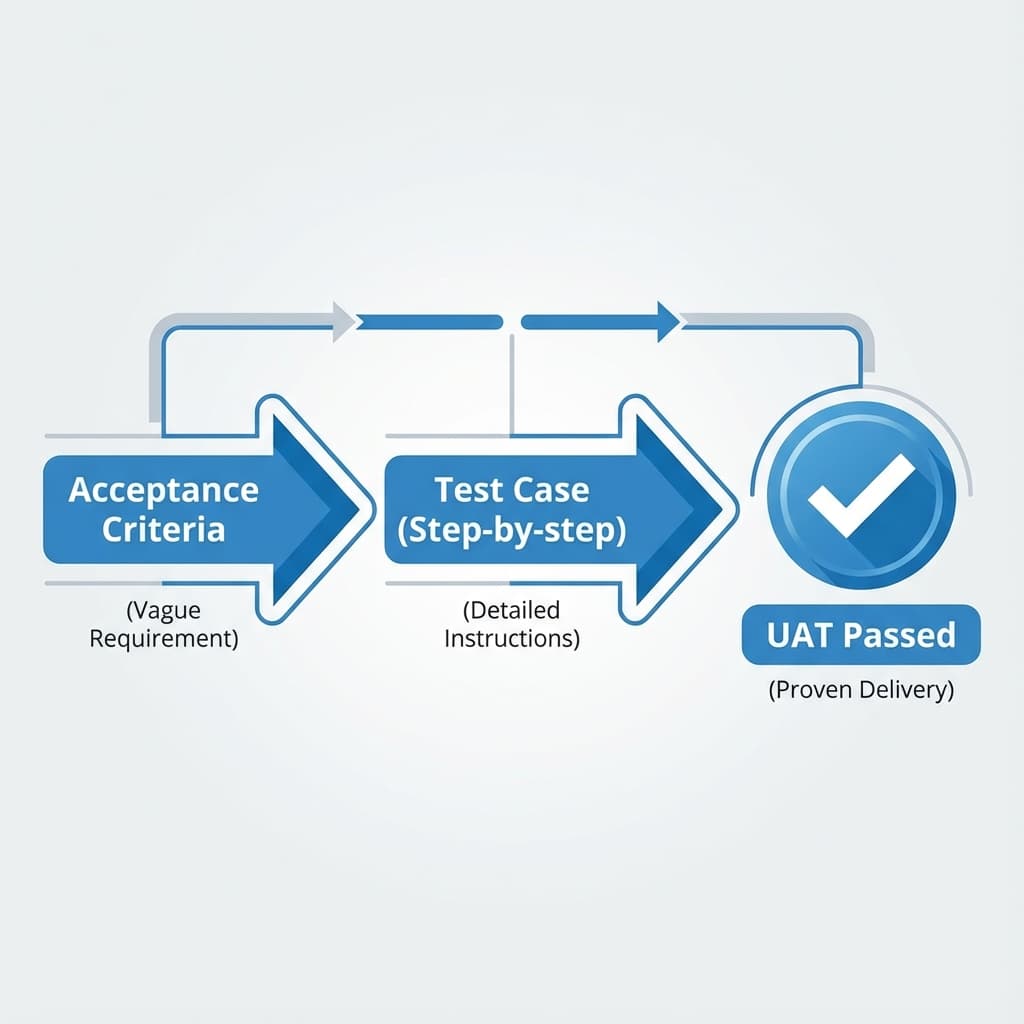
1. Acceptance Criteria (AC): The Contract
Written during Analysis Phase.
AC is the promise. It describes the condition.
"User cannot submit form without a valid email."
2. Test Case (TC): The Script
Written before Development finishes.
TC is the proof. It describes the action.
"Step 1: Enter 'invalid-email'. Step 2: Click Submit. Step 3: Verify error message appears."
3. UAT Sign-off: The Money Trigger
Executed at Delivery.
Sign-off is the closure. It acknowledges the result.
"I confirm that Test Case #12 passed."
The Cost of Ambiguity
Why do we need this rigor? Because "intuition" is expensive. If you rely on the client to "just test it," they will test based on their mood, not the requirements.
- Vague Feedback: "I don't like how this feels." (Unactionable, infinite hours)
- Test Case Feedback: "Step 3 failed. The error message was missing." (Actionable, 10 minutes)
When you force testing into a linear pipeline, you strip away the emotional overhead of delivery.
Deep Dive: From Vague to Verified
Let's look at how a single feature evolves through this pipeline. Feature: Guest Checkout
| Stage | Input | Clarity |
|---|---|---|
| Requirement | "Users can buy without logging in." | 🚩 Low. Does it save info? What about email? |
| Acceptance Criteria | "Guest cart must persist after refresh. Email required for receipt." | ⚠️ Medium. What happens if I refresh twice? |
| Test Case | "1. Add item. 2. Refresh page. 3. Verify item remains. 4. Check LocalStorage." | ✅ High. Binary Pass/Fail. |
If you skip to development from "Requirement," you are guessing. If you convert to "Test Case" before coding, you are executing a script.
Who writes the script?
A common question is: Who does this extra work?
| Role | Responsibility | Output |
|---|---|---|
| PM / Business Analyst | Defines the "What" | User Stories & Acceptance Criteria |
| QA / Lead Dev | Defines the "How" | Test Cases (Step-by-step instructions) |
| Client / Stakeholder | Confirms the "Yes" | UAT Execution & Sign-off |
The client should never write the test cases. They should only execute them. Your job is to hand them the clipboard and say, "Check these boxes."
How to execute UAT without fighting
Many PMs and freelancers skip UAT because they think it's "just testing." Real UAT is political. It is about forcing a decision.
Rule 1: Never send a "Play around with it" link
If you just send a staging link and say "let us know what you think," you are digging your own grave. You will get 50 opinionated tickets about colors and spacing.
Always send the Test Sheet. Force the client to check boxes. Yes/No. Pass/Fail.
Rule 2: Failing a test is good
If a specific test case fails, that is not a disaster. That is a bug report. It limits the scope of the problem to that specific feature. It prevents "Everything is broken" panic.
Rule 3: The Sign-off is binary
Once all critical test cases pass, the project is Done. Any feedback after sign-off is a Change Request.

uDocit's role in your defense
We built uDocit to handle the front-end of this pipeline: Requirements and AC. By standardizing Acceptance Criteria in your User Stories, you are pre-writing your UAT script.
(Expect more updates soon on generating Test Cases directly from your AC.)
Takeaway Don't deliver code. Deliver passed tests. The shield against scope creep is a signed checkmark.